
Utah Parole Board Authority
The official decision maker is the Utah Board of Pardons and Parole. It is separate from the sentencing court and the Utah Department of Corrections. The court imposes the statutory sentence. UDC confines the person and later provides supervision when parole begins. The Board decides whether and when parole occurs within its legal authority, and it can also address sentence termination, pardons, commutations, certain fines or forfeitures, and other actions allowed by statute.
Utah uses an indeterminate prison model for ordinary cases. That means the sentence states a range rather than promising one fixed release day. A Board hearing fits within that range. The Board reviews the legal and case record, then issues an executive-branch decision distinct from the judgment entered by the court. A favorable result can lead to parole, but parole is conditional release from prison, not the end of the conviction or sentence.
The Board’s official hearing and review types describe the different proceedings that can appear in the public record.
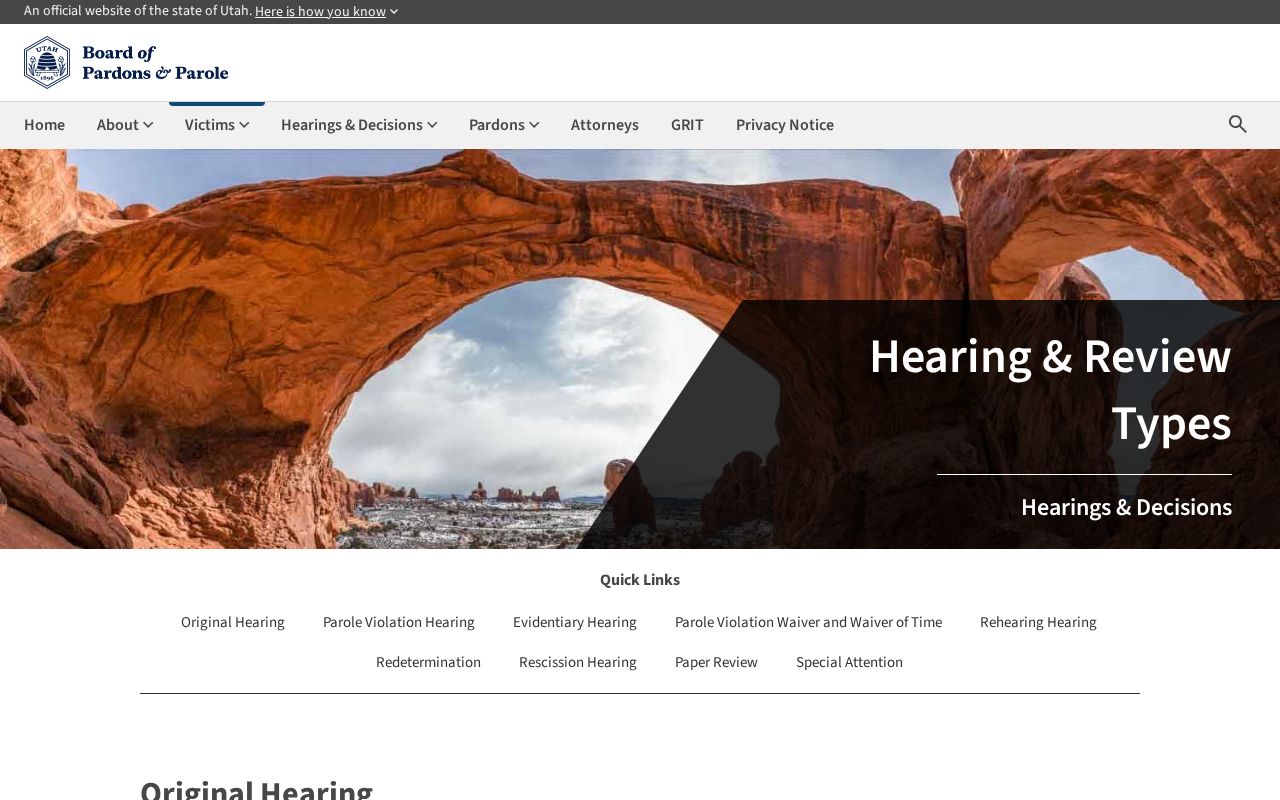
The type label is essential because an original hearing, violation hearing, and termination review answer different release questions.
Find a Utah Parole Hearing
The Board’s Search Hearings and Decisions system is both the offender-results tool and the live calendar. It is not a static monthly PDF. A user may search by offender name or number, hearing date, or decision date. Name searches account for known aliases. Date searches must be limited to no more than seven calendar days, so a month requires several consecutive, non-overlapping searches.
- Open the Board’s hearing and decision search. Select the offender route when a name or offender number is known.
- For a calendar sweep, choose Hearings and enter a date span no longer than seven days.
- Repeat with the next date span until the needed month or period is covered. Do not overlap dates, which can create duplicate results.
- Match the offender name and number. Read the hearing date, time, type, location or live link, and any final expiration date shown.
- Run the search again near the event. The calendar is live, and a pending matter or schedule can change.
The Search Hearings and Decisions page is the calendar of record for Utah parole hearings.
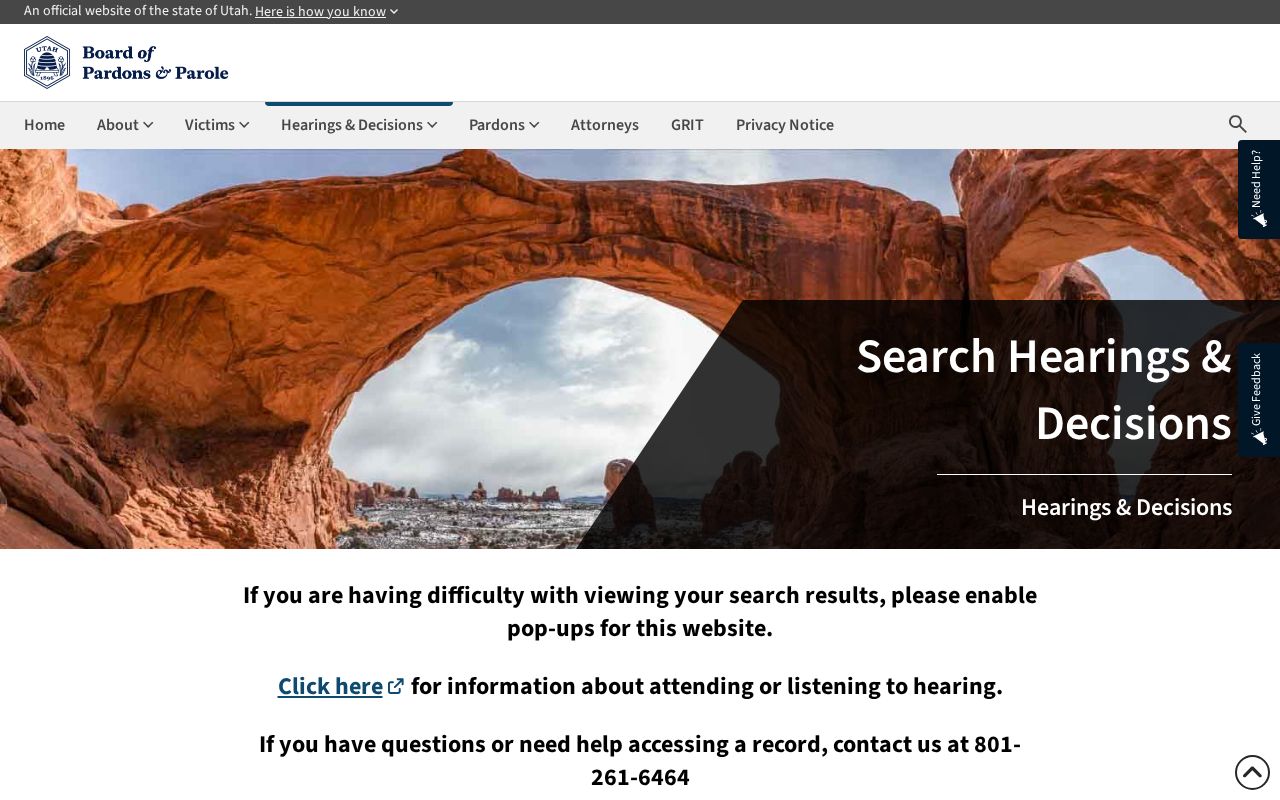
Its separate hearing and decision date modes prevent a scheduled review from being confused with a final result.
Utah Parole Hearing Broadcasts
The live-hearing page identifies Salt Lake and Gunnison calendars. Salt Lake streams ordinarily run Monday through Thursday, while Gunnison streams ordinarily run on Tuesdays. Since March 17, 2025, public broadcasts have been audio-only. These details help a member of the public locate the correct live session, but they do not change the legal effect of the hearing or replace the later written order.
No current authoritative Board page promises a fixed daily or weekly publication schedule for all results. The defensible approach is to treat the interface as live and event-driven. Recheck close to the hearing, then return after the event for the decision. A pending result can change, and a broadcast ending does not mean the final order has already been posted.
The Board’s live-hearing page supplies the current broadcast links and calendar labels. Match the location shown in the hearing result before choosing a stream.
Note: A live broadcast helps observe a proceeding, while the linked final order provides the durable public record of the action.
Search Utah Parole Decisions
Decision results are found in the same Board system. Switch from Hearings to Decisions when searching a date range, or use the offender search to gather that person’s sequence of events. A decision result can include the final-decision date, decision text, details, and a linked order. The latest order matters most because a later redetermination, rescission, violation action, or termination can change what an earlier entry meant.
- Search by offender name or number and confirm the identity against the offender number.
- Open the most recent decision result. Record its decision date and the exact action stated.
- Open the linked order when available. Note the order date, effective date, conditions, contingencies, or next review.
- Check the result list for later orders. Do not stop at the first parole grant.
- Compare the final order with UDC Release Date/Type and current location or facility-placement information.
The UDC offender search provides the separate corrections record used for that comparison.
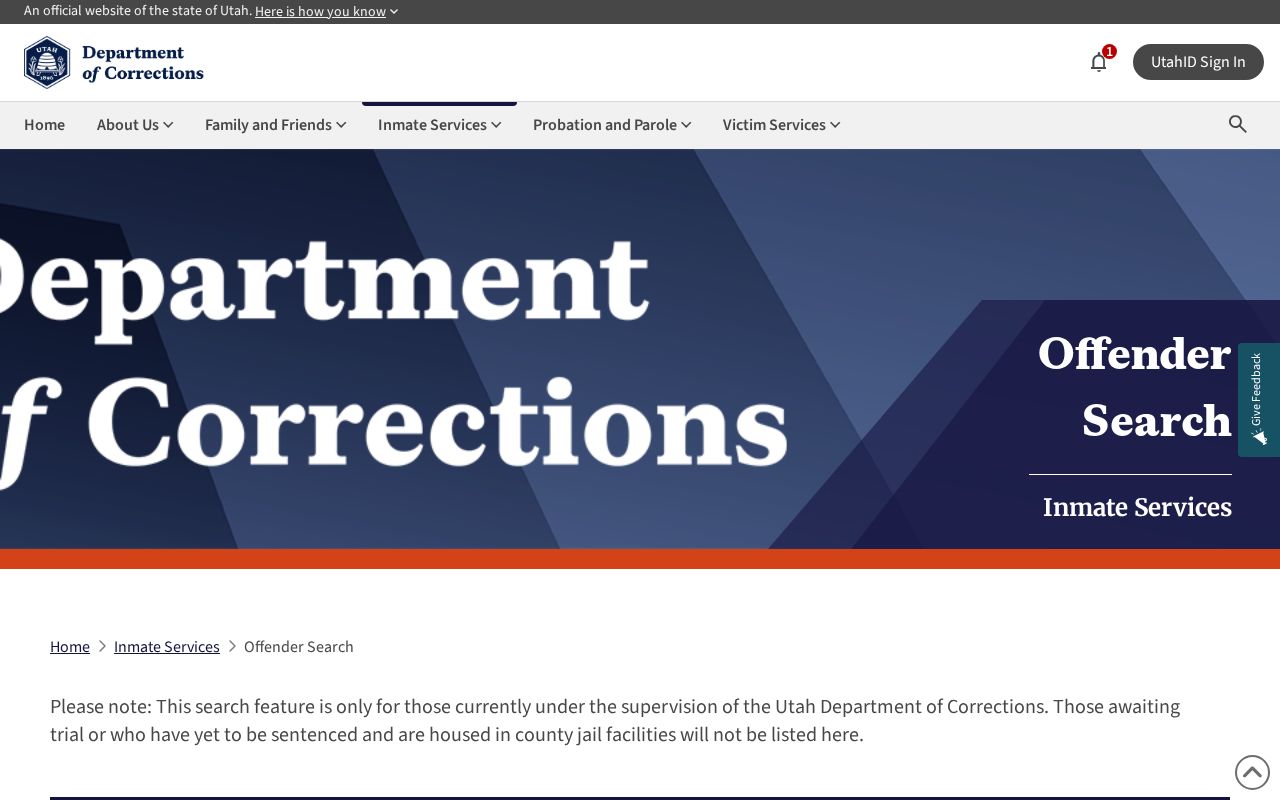
A future Release Date/Type value should be checked against the latest Board order rather than treated as a stand-alone promise.
The full UDC offender-search record path explains why a person under parole can remain searchable after leaving prison.
Utah Parole Hearing Outcomes
Outcome language must be read in context with the hearing type and the final order. The Board distinguishes original hearings, rehearings, redeterminations, rescission hearings, parole-violation hearings, evidentiary hearings, paper reviews, special-attention matters, and termination or expiration reviews. Those labels describe the process. The decision and order describe the result.
| Record result | Meaning | Next check |
|---|---|---|
| Parole granted | Conditional release from imprisonment was authorized, often subject to an effective date or contingencies | Read the final order and compare UDC Release Date/Type |
| No date granted or rehearing | An original review did not produce a release date at that stage | Record the next review or rehearing information |
| Redetermination | The Board revisits a prior matter or date | Use the newest order rather than the earlier one |
| Rescission | A previously granted date can be removed through the applicable proceeding | Check custody status and the rescission order |
| Termination or expiration | The record concerns the end of supervision or sentence, not merely release from prison | Preserve the final order as the key end-status record |
A parole-violation hearing is different again. It concerns someone who was already released to parole and is alleged to have violated conditions. It may lead back to confinement. The hearing search is not a warrant database, and a listed violation proceeding is not a new grant.
- Effective date
- The date an order’s action is set to take effect, subject to its exact terms.
- Contingency
- A stated condition that must be met before an ordered step can occur.
- Rescission
- A Board process that can remove a previously granted release date.
- Expiration
- The lawful end point of the sentence or supervision reflected by the controlling record.
Utah Parole Hearing Eligibility
Utah Code §77-27-7 supplies a hearing-schedule framework. For a person serving a felony or class A misdemeanor sentence, the Board generally sets a hearing within six months after commitment to UDC and gives prompt notice, subject to the statute’s treatment of unresolved criminal matters. That schedule is a process rule. It does not promise that parole will be granted at the first hearing.
When choosing a date, the Board considers offense severity, criminal history, criminogenic risk factors, and evidence-based assessments. A criminogenic factor is one associated with the risk of repeat offending and the needs considered in correctional planning. Under Utah Code §77-27-9, release generally cannot occur before the minimum term unless the Board uses the statute’s mitigating-circumstances route and makes the required findings. Mandatory-minimum and life-without-parole provisions create further limits.
The Board’s guidelines inform review but do not create an entitlement. Its starting-process and decision-factors materials identify the guideline date, presentence information, offense, risk and needs, and other lawful case material as parts of the review. Eligibility means the matter may be heard within the legal framework. Approval requires an actual Board decision.
The Utah hearing-scheduling statute provides the process rule, while Utah’s parole-proceedings statute addresses the central release limits.
Utah Pardons and Commutations
Utah places pardon and commutation authority with the Utah Board of Pardons and Parole rather than treating it as an act of the governor alone, except where law limits the Board. These powers sit beside parole authority but produce different legal outcomes. A pardon, commutation, parole grant, and sentence termination should never be used as interchangeable labels.
A parole grant releases a person from imprisonment under conditions. A commutation changes punishment through the Board’s authority. A pardon is a distinct clemency action. A termination or expiration record addresses the end of the sentence or supervision. The actual Board order must be checked to know which action occurred and when it took effect.
The Utah Board of Pardons and Parole identifies the agency and its public functions. The Board order, rather than a general agency page, establishes the clemency or parole action itself.
For record review, preserve the exact action, order date, effective date, and any later order. Do not infer a pardon from disappearance in a search tool. A fully discharged person can fall outside UDC’s stated offender-search scope even when no clemency action occurred.
Utah Parole Policy Revision
UDC and BOPP announced revised parole conditions effective for people released on or after December 10, 2025. The agencies described the update as the first broad revision in a decade. They said the new conditions use clearer language, reduce repeated terms, and align with statutory changes while preserving supervision tools. This is a dated policy change, not proof that one person received any listed condition.
The official parole-conditions announcement establishes the effective date and stated purpose. A person whose parole began before that date may have different issued terms. The current order and conditions for the individual remain the decisive records.
The revision also reinforces the line between the hearing decision and post-release supervision. The Board decides the parole action and conditions. UDC AP&P supervises those conditions after release. Details about that later phase belong in the Utah parole and probation record, not in a hearing calendar entry.
Note: Record the release date and issued condition set before applying a statewide policy summary to an individual parole case.
Confirm a Utah Parole Release
A final parole check uses more than one record. First, read the most recent Board order. Capture the exact result, order date, effective date, contingencies, and later actions. Next, compare UDC Release Date/Type and current location or facility placement. If the person has physically left prison but remains on parole, the UDC result may still appear because supervision continues.
If the order and public UDC fields conflict, ask UDC for a releasable sentence-calculation or movement record. A county jail roster should be consulted only when there is reason to believe the person returned to local custody or was held there. A missing live roster entry does not establish community release because transfer to state, federal, or another local custodian remains possible.
The UDC public information and GRAMA page provides the official records-request route for releasable corrections material.

That fallback can clarify movement or legal-status fields when the public search and Board order do not align.
That sequence keeps three events apart: eligibility for a hearing, a Board decision, and physical release. They can happen on different dates. Only the final records show whether supervision later ended through termination or expiration.